Zambia’s private sector business conditions expanded further in June
Mauritius: Consumer inflation was unchanged 7.9% y/y in June, coming in slightly higher than our 7.7% estimate. CPI rose by 0.4% m/m, following a 0.2% increase in May as increases in alcoholic beverages & tobacco prices (+7.0% m/m), recreation & culture (+0.6%) and restaurant & hotels (+1.9%) offset decreases in food & non-alcoholic beverages (-0.3%), housing
Zambia’s private sector business conditions expanded further in June
Mauritius: Consumer inflation was unchanged 7.9% y/y in June, coming in slightly higher than our 7.7% estimate. CPI rose by 0.4% m/m, following a 0.2% increase in May as increases in alcoholic beverages & tobacco prices (+7.0% m/m), recreation & culture (+0.6%) and restaurant & hotels (+1.9%) offset decreases in food & non-alcoholic beverages (-0.3%), housing & utilities (-0.4%) and transport (-3.0%). Clothing & footwear, health and miscellaneous goods & services prices were also up during the month. Looking ahead, we expect favourable base effects to support a deceleration in inflation to a projected 5.0% y/y by year-end and an average of 7.4% in 2023 (10.8% in 2022), which is higher than the 6.8% forecast of the Bank of Mauritius.
The MPC kept the policy rate unchanged at 4.5% on 15 June despite the still elevated inflation profile; therefore, we do not anticipate a change in the policy rate over the remainder of the year, particularly given our expectation for inflation to ease.
Separately, tourist arrivals rose 30.4% y/y in June, following a 42% increase in May. Tourist arrivals rose to 596,466 in H1, a 58.4% increase compared with the corresponding period in 2022 and just 8.2% below pre-pandemic (2019) arrivals. Although we anticipate arrivals to edge closer this year to pre-pandemic 2019 total of 1.4mn, we expect base effects and a weaker global macroeconomic backdrop to result in slower growth in arrivals this year following the 455% surge seen in 2022.
Zambia: Private sector business conditions continued to expand in June, albeit at a marginally weaker pace than in May. The PMI came in at 51.2 in June, compared with 51.4 in May, with output and new orders continuing to improve amid better access to cash and relatively muted inflationary pressures. Growth was recorded across all five broad sectors monitored in the survey. Signs of improving economic conditions helped firms secure new customers, feeding through to greater new orders.
This, in turn, resulted in some companies increasing staffing levels, leading to the first net increase in employment in five months. Notably, the survey showed that overall cost pressures were relatively muted in June even as staff costs increased.
Zambian firms remained hopeful that the recent trends of improving new orders, FX appreciation and muted inflation will continue in coming months, supporting ongoing growth of activity. The survey showed that confidence strengthened to the joint-highest level in the past 18 months.
Gabon: Shortly after Senegal’s President Sall announced that he will not be seeking a third term in office, Gabon’s President Bongo announced yesterday that he will be doing so. Bongo succeeded his late father (Omar Bongo) in 2009 and was re-elected for another 7-year term in 2016. News reports suggest that his Gabonese Democratic Party will endorse him today (10 July) as its candidate. The next presidential elections are scheduled to be held on 26 August (Anadolu Ajansi). There are no constitutional term limits in Gabon although the national assembly, in April, reduced the presidential term from seven to five years. Around 15 candidates have announced their intention to run in the upcoming presidential elections, with tomorrow (11 July) being the deadline for such an announcement.
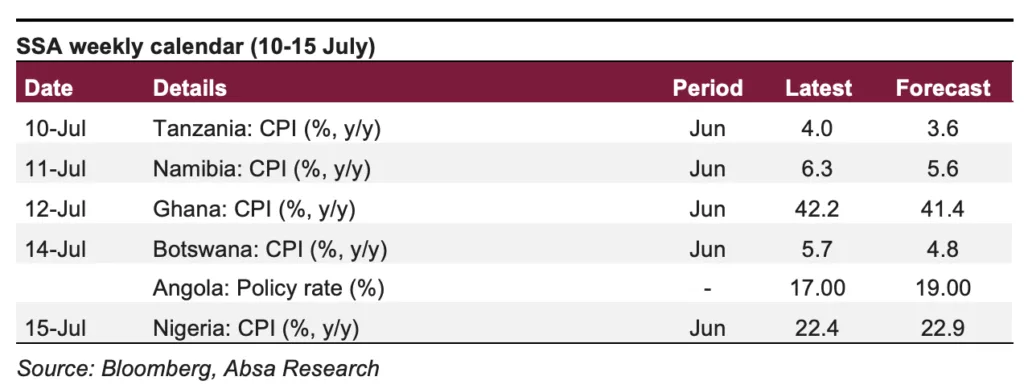
Week ahead: The week ahead calendar is dominated by June CPI releases, with the National Bank of Angola’s (BNA) MPC meeting the only other major event. Against the backdrop of a rapidly depreciating exchange rate, the BNA brought the next MPC meeting forward from 17-18 July to 14 July. Although Angola’s inflation was unchanged at 10.6% y/y in May from April, we believe the 38% depreciation of the kwanza against the USD since mid-May and steep fuel prices hikes after the removal of the fuel subsidy threaten inflation and could see a policy rate hike of up to 200bp at this meeting.
It will be the first MPC meeting for newly appointed Governor Dias, who promised last month to implement policies to ensure the stability of prices and the kwanza. Amongst the CPI releases, we expect Tanzania’s June inflation print today. We expect inflation to come in at 3.6% y/y compared with 4.0% in May, reflecting favourable food and fuel base effects. However, weaker exchange rate during the month poses upside risk to our forecast. The combination of favourable base effects and lower diesel prices is likely to have pushed Namibia’s inflation rate lower to 5.6% y/y in June, from 6.3% in the prior month.
Absa reports expect considerable focus on Ghana’s June CPI print after the surprise increase in inflation in May that disrupted four months of deceleration. The group expect base effects and a relatively stable cedi during the month to have helped inflation ease to 41.4% y/y in June from 42.2% in May. A significantly faster fall in inflation looks unlikely given the higher water tariffs that were implemented on 1 June. Botswana’s June inflation print is also due out on Friday, 14 July. After decelerating to within the central bank’s 3-6% inflation target band for the first time in two years in May, when inflation came in at 5.7% y/y, it project inflation to have fallen further to 4.8% in June, reflecting base effects.
Finally, Nigeria’s National Bureau of Statistics has scheduled the release of its June CPI report for Saturday, 15 July. Following the removal of the fuel subsidy on 29 May and the FX reforms in early June that saw the exchange rate weaken sharply, we believe inflation may have risen to 22.9% y/y in June, up 0.5pp from May. However, we caution that with petrol prices more than doubling and the cost of imports likely to have surged, there is significant risk around this projection.