
Robust tax receipts in December point to a deficit undershoot
The National Treasury yesterday published fiscal data for the main budget in December. The main budget posted a surplus of R45bn, with broad-based strength in tax collections. For April to December, the cumulative deficit is now 16.4% lower than the same period a year earlier, versus an MTBPS forecast of an unchanged deficit in FY22/23

Robust tax receipts in December point to a deficit undershoot

The National Treasury yesterday published fiscal data for the main budget in December. The main budget posted a surplus of R45bn, with broad-based strength in tax collections. For April to December, the cumulative deficit is now 16.4% lower than the same period a year earlier, versus an MTBPS forecast of an unchanged deficit in FY22/23 from FY21/22. While this might suggest some risk that the main budget deficit this year could undershoot the MTBPS target of 4.9% of GDP, some caution is warranted given that consumption-related taxes and corporate profitability will have been hard hit by load shedding. We now forecast a deficit outcome in FY22/23 of 4.6% of GDP.
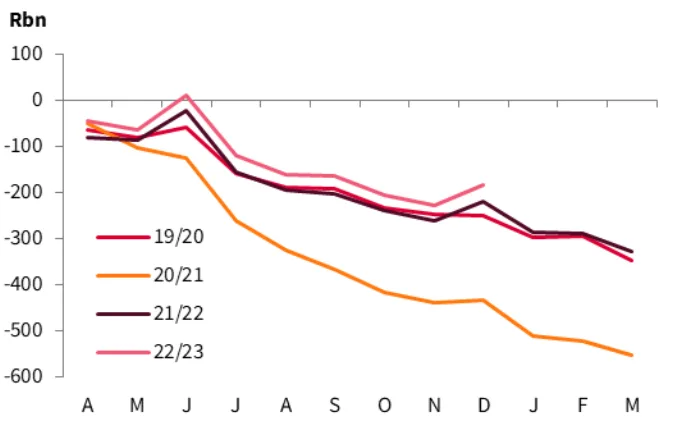
The main budget balance for December came in at R45bn surplus. This outcome, which was pretty much in line with provisional financing data, is 7.4% higher than a year earlier. We view this as a strong outcome, given the lower commodity prices and economic turmoil (including a Q2 22 GDP contraction) since then. It sustains, rather than surrenders, the strong fiscal gains made in the early part of FY22/23 and moves the cumulative deficit for the first 9 months of the fiscal year to R183bn, some 16.4% lower than the deficit in the same period in FY21/22 (Figure 1). This stands in marked contrast to the National Treasury’s updated main budget deficit target in the Medium Term Budget Policy Statement (MTBPS) that the main budget would post a deficit (in rand terms) this fiscal year almost identical to FY21/22. On the surface, this would seem to suggest that the government will secure a main budget deficit in FY22/23 below the 4.9% of GDP target in the MTBPS. However, it should be borne in mind that tax collections could soften in Q1 23, with intense load shedding likely to hit VAT receipts and other taxes on consumer spending, as well as corporate profitability. With that in mind, we now forecast a main budget deficit in FY22/23 of 4.6% of GDP
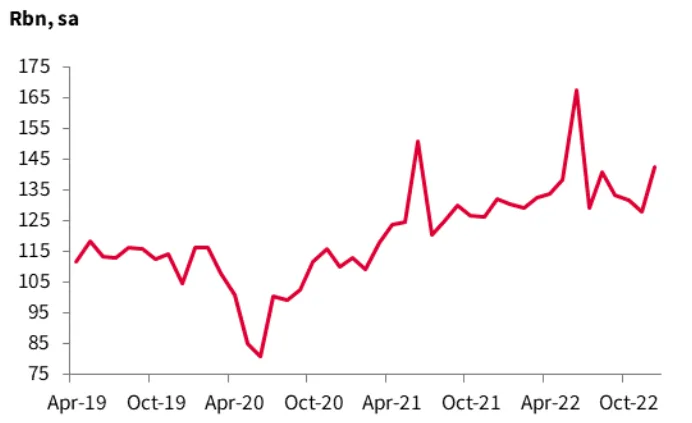
The December outcome owes to still-robust tax collections, but load shedding will likely hurt. After some weakness in September-November, when gross tax collections grew only 2.7% y/y on average, they increased by 8.8% in December (Figure 2). Personal income taxes (PIT) in particular posted a second consecutive strong month with growth of 11.8% y/y in December. Meanwhile, corporate income tax receipts were up 3.9% y/y in December, which is an exceptionally strong and somewhat unexpected performance given the decline of commodity export prices and the challenges that bulk mineral producers have experienced with Transnet’s freight rail logistics. But readers may recall that the MTBPS noted strong CIT results in June, also owed to good profitability in the finance and manufacturing sectors. However, the hit to manufacturers’ bottom lines from diesel generator costs to ride through the intensified load shedding have likely been significant. Meanwhile, after soaring in November, VAT refunds slumped in December. This left net VAT receipts up 21.8% y/y in December, after a 21.5% fall in November, with the two months together down 0.8% overall. Meanwhile, in a similar pattern to that shown by revenues, main budget expenditure rose 7.8% y/y.