
Board Member's Abandoned Farm Business Absorbed R4.6 Million in Lottery Funds
A hydroponic vegetable farming project in the Lekgalong area of North West, initiated by a non-profit company affiliated with the former National Lotteries Committee (NLC) board member William Huma, has raised concerns after receiving a R4.6 million lottery grant. The project's goal was to create jobs and provide fresh produce to the region's impoverished communities.
Board Member's Abandoned Farm Business Absorbed R4.6 Million in Lottery Funds
A hydroponic vegetable farming project in the Lekgalong area of North West, initiated by a non-profit company affiliated with the former National Lotteries Committee (NLC) board member William Huma, has raised concerns after receiving a R4.6 million lottery grant. The project’s goal was to create jobs and provide fresh produce to the region’s impoverished communities.
However, the project has been abandoned for more than two years, and there is little transparency regarding the use of millions of rands allocated to Reagile, the non-profit involved. The grant was given to Reagile on August 19, 2021, just before Huma resigned from the NLC board due to allegations of corruption involving lottery grants.
Surprisingly, despite the grant’s intended purpose, the funding was allocated under the NLC’s Arts, Culture, and National Heritage sector.
According to the company’s registration with the Companies and Intellectual Property Commission (CIPC), Reagile’s primary goal is to engage in farming and agricultural projects in rural communities, providing training and employment opportunities to women and youth in those areas.
The Special Investigating Unit (SIU) is currently looking into Reagile’s R4,658,118 grant.
Reagile was founded in 2017 by a firm specialising in the creation and sale of shelf companies. A shelf company is a pre-registered entity that has never done business or accumulated assets or liabilities. Essentially, it is dormant until someone buys it.
On March 6, 2020, Reagile was purchased as a shelf company. Shortly before the NLC approved the grant, the company appointed new directors, including Lorato Moyo, Huma’s then-girlfriend (now wife), as well as other family members and a close friend. The company’s founding and selling directors resigned on the same day the new directors were appointed.
Inquiries sent to Huma’s email address were not returned.
Neglect and abandonment
According to a source familiar with the project, Huma described it as a “pilot” project aimed at tomato cultivation. The primary goals were to create job opportunities for local residents and to supply nearby communities with affordable, fresh vegetables. However, these goals were never met.
“The project never really took off and was abandoned,” the source said. “It didn’t employ anyone and didn’t sell much produce, if any.”
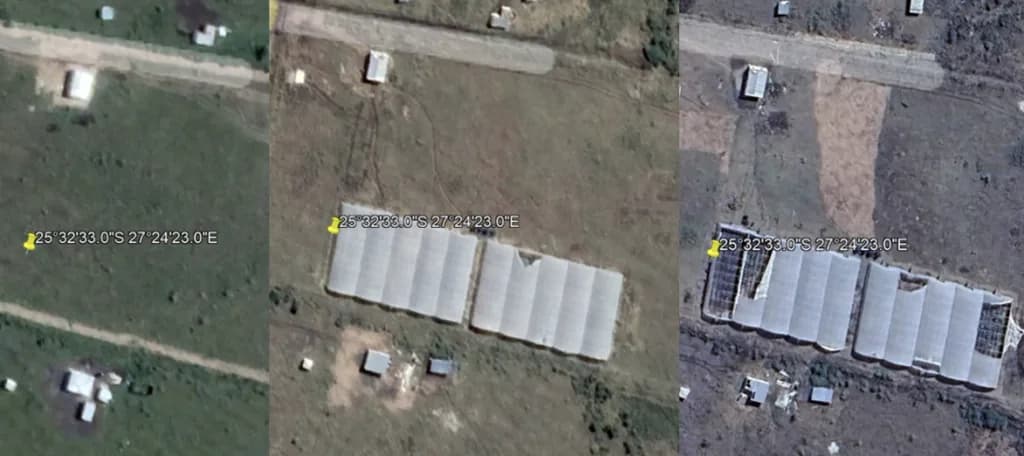
A recent Google Earth satellite image, taken on April 27, 2023, shows severe damage to several vegetable-growing tunnels. Following the project’s abandonment, these structures appear to have been neglected and exposed to the elements.
When satellite images from February 2021 to October 2021 are compared, ten grow tunnels are visible on the property. However, visible damage had been observed at the front of one of the tunnels by April 14, 2022. A year later, half of the tunnels were severely damaged.
While the exact dimensions of the tunnels are unknown, quotes obtained by GroundUp from a reliable supplier indicate that prices range from R7,500 for a 3m x 6m “B grade” tunnel to R68,500 for a high-end 12m x 30m tunnel. Plastic covering, VAT, delivery, and construction are not included in these prices. Even with the most expensive tunnels, add-ons, and VAT, the total cost of the ten tunnels is far less than Reagile’s R4.6 million grant. “Huma and Ms Moyo controlled the finances and everything else,” a source familiar with the project said. The majority of the directors were unemployed and desperate for work, and this was their big break. They were, however, kept unaware of the project. Huma has left them high and dry. This ordeal has made them unhappy and depressed. Furthermore, the SIU is now questioning them about the grant and their involvement.”
Financial Issues
When applying for NLC funding, Reagile would have had to submit two years’ worth of financial statements in accordance with the Lotteries Act. However, because Reagile was founded as a shelf company, it would have had no prior business activities, making it unable to meet the two-year financial statement requirement.
GroundUp has reviewed unsigned financials for Reagile dated February 28, 2019, which show the company was financially active. However, the new directors were not appointed until March 6, 2020, after the fiscal year ended in 2019.
During lottery corruption investigations, fake financial statements were submitted to the NLC, as evidenced by Life for Impact in the 21st Century, which used fabricated financials when applying for funding for a youth awards ceremony.
Lottery Advantages
Huma is not the only one who has allegedly benefited from a lottery grant.
A lottery-funded poultry farm on a smallholding owned by Silverlite Trading, a private company of which Huma is the sole director, is a 20-minute drive away from the project site. Following an application to the Special Tribunal, the Asset Forfeiture Unit (AFU) froze the poultry farm earlier this year. The farm, which closed down last year and never made a profit, has been repeatedly targeted by thieves, and security personnel on the property have been attacked.
The poultry farming project received a R13 million Lottery grant from The Samaritan Initiative, a non-profit organisation dedicated to empowering women in Marikana, the site of a tragic mining strike in 2012.
In March 2016, the Samaritan Initiative was registered with the Department of Social Development (DSD). According to CIPC records, the organisation was dormant and non-compliant when the NLC approved the grant. It also lacks an online presence. None of the registered directors were involved in the poultry farm, and the non-profit appears to have been hijacked. Furthermore, given the improvements made to the property, it is unlikely that the entire R13 million grant was used there. The NPO had failed to submit financial statements or other statutory reports to the DSD, raising concerns about the NLC’s diligence prior to awarding the grant.
Luxury Investments
GroundUp previously reported on the NLC’s approval of a R20 million grant to the Matieni Community Centre in 2017 for the construction of an old age home in the rural village of Marapyane. Within a week, attorneys involved in the sale of a luxury estate in Rustenburg received R5 million of the grant.
Matieni’s payment to the lawyers was intended for the purchase of a luxurious property in Rustenburg by BDH Group (Pty) Limited, the sole director of which was William Huma. The property was later converted into a boutique hotel, and it was also frozen by the Special Tribunal.
According to investigations, grant money was also deposited into Huma’s bond account for his luxury home in Pretoria.
Furthermore, in late 2016, just months before his appointment to the NLC’s board on April 1, 2017, Upbrand Properties made two separate R1 million payments to Huma. Upbrand has ties to former NLC Chief Operating Officer Philemon Letwaba, who resigned last year while facing a disciplinary investigation.
At the time, Huma stated that both payments were instalments toward Daisy Letwaba’s purchase of Just Cuban, an upscale restaurant and music venue in Pretoria.
Allegations of corruption and mismanagement have cast doubt on the allocation and use of lottery funds. The aforementioned cases highlight the need for more stringent oversight and accountability to ensure that lottery funds are used to benefit communities and support projects that benefit marginalised groups. The investigations and participation of bodies such as the SIU are critical steps in addressing these concerns and restoring public trust in the lottery system.