Eskom is rapidly running out of load shedding levels
Current statistics indicate that Eskom would run out of load shedding stages around August 2023 unless major actions are made. According to Pieter Jordaan, an independent energy expert, the daily mean load shedding stage – or average stage for the day – has been continuously growing since July 2022, when it closed at stage 4

Eskom is rapidly running out of load shedding levels

Current statistics indicate that Eskom would run out of load shedding stages around August 2023 unless major actions are made.
According to Pieter Jordaan, an independent energy expert, the daily mean load shedding stage – or average stage for the day – has been continuously growing since July 2022, when it closed at stage 4 for the first time.
Since then, the average has reached stage 4 52 times and is constantly increasing higher until the end of February 2023.
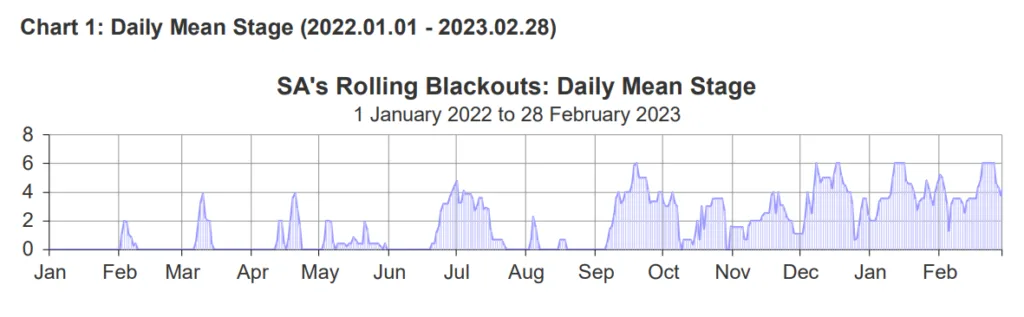
Plotting the averages over a medium-term load shedding trend – a 91-day moving average of the daily mean stage – reveals that the load shedding mean is heading upwards and might break through stage 8 in August 2023 if no meaningful interventions are made.
According to Jordaan, several outliers from the pattern have occurred, most notably the labour unrest suffered by Eskom in the middle of 2022, which pushed South Africa into stage 6 for the first time in years.
There was also a divergence when Eskom ran out of diesel in November 2022 and over the holidays at the beginning of 2023, but the rolling average reverted to the trendline in each occasion, he added.
Jordaan’s data demonstrates that the labour unrest in 2022 marked the beginning of the rise of load shedding in South Africa.
“There was a departure from the previous norm, starting around the time of the labour unrest,” he said. “Prior to that event, emergency conditions would produce weekly mean stages of between 1 and 2. However from then onward, emergency levels rapidly started to escalate.”
The weekly mean stage during 2022 crises was 3.8 on 3 July, 4.8 on 25 September, and 5.2 on 18 December 2022. On February 26, 2023, stage 5.8 broke these records.
Jordaan’s research reveals another troubling trend: there is no longer a stage 0 recovery.
Since September 2022, South Africa has been in a near-permanent state of load shedding. While Eskom attempted to cease load shedding on two consecutive occasions at the beginning and end of October, it has been unable to completely avoid load shedding since then.
The country has been load shed for 123 days in a row as of March 2nd.
“Before September 2022, weekly emergency mean stages recovered to zero within a week or two. After September 2022, the recovery points – or, the lowest point after a new high point – have crept upwards in a straight line,” the analyst said.
The emergency creep is 105 days, or the duration between each new high point in the average load shedding stage. At 50 days, the recovery creep – the new low point – is growing at a quicker rate.
In practise, this implies that South Africa experiences a fresh peak in load shedding every 105 days, but the recovery point is worsening, rising higher every 50 days.
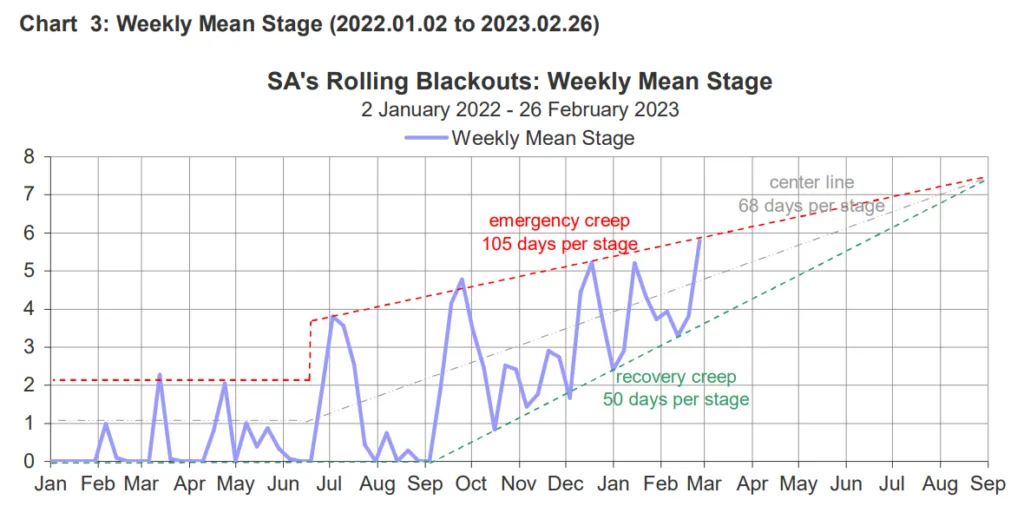
According to the trend line, South Africa would experience one higher level of load shedding every 68 days, culminating above stage 7 by the end of August 2023.
“From the analysis and projections, it is evident that Eskom cannot continue the above trends without revising their schedules to higher levels,” Jordaan said.
“However, Eskom’s dilemma is that higher levels of load shedding impacts the revenue they must earn to restore generating capacity, and Eskom has already sold 25% less energy to its premium rate customers in 2023, due to load shedding,” he said.
Eskom has acknowledged that it is actively updating its load shedding schedules, with the System Operator engaging with appropriate authorities to evaluate the load shedding legislation.
Changes to the timetables will involve the addition of extra load shedding phases, though it has not been determined to what degree they would finally go. The process also has a long way to go, since it requires regulatory clearances and feedback from numerous stakeholders.
Economists and analysts have warned that despite promises from the government to get new capacity online and having load shedding resolved within two years – or even sooner – South Africans should expect the situation to get worse, particularly in the coming months as the country heads into winter and energy demand shoots up.