Central African Republic Revives Plans for Fibre Optic Link to DRC
The Central African Republic (CAR) plans to revive a fibre-optic interconnection project with the Democratic Republic of Congo (DRC), potentially giving the landlocked country a third terrestrial route to international submarine cables.
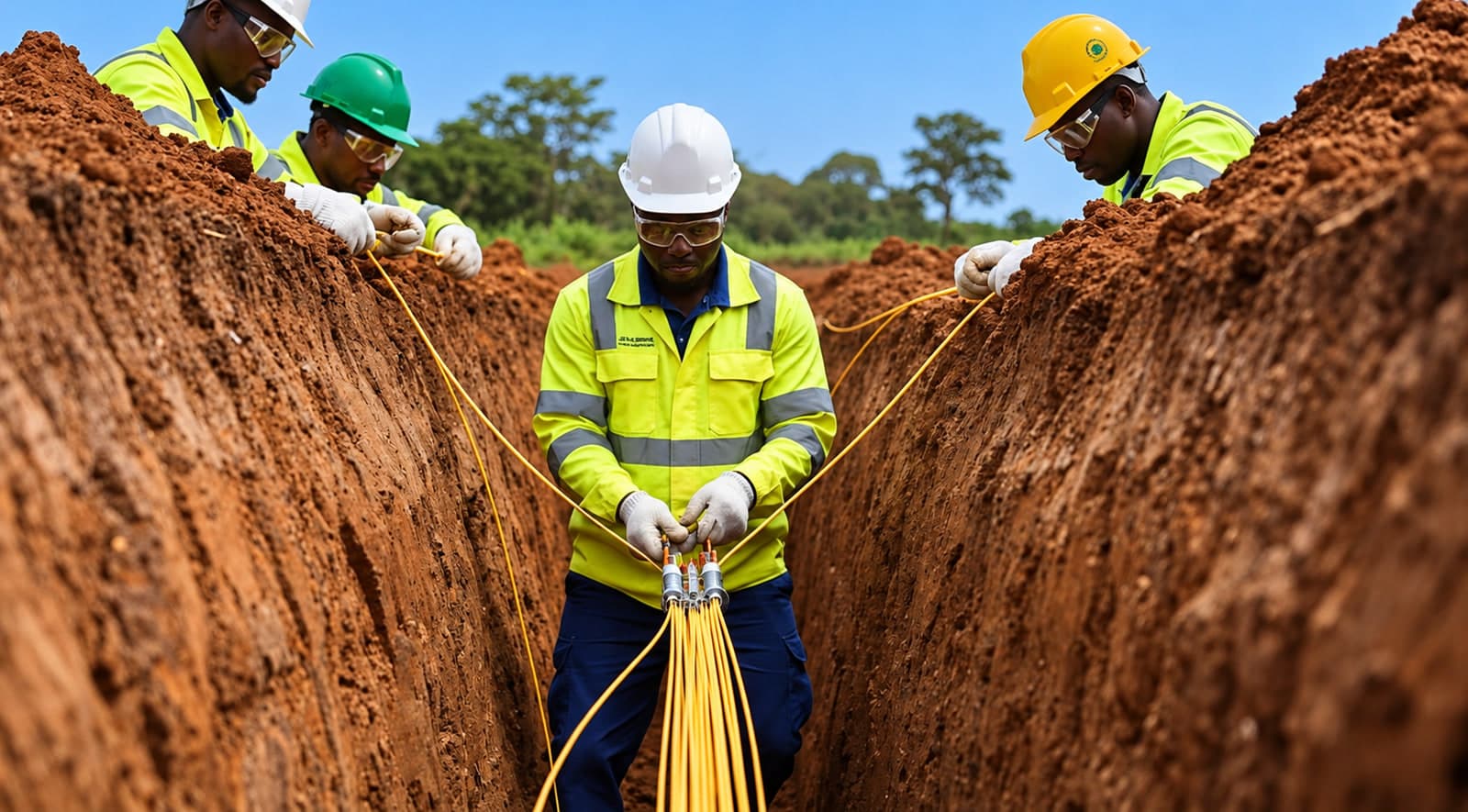
Fibre Optic Installation Team
The Central African Republic (CAR) plans to revive a fibre-optic interconnection project with the Democratic Republic of Congo (DRC), potentially giving the landlocked country a third terrestrial route to international submarine cables.
CAR’s Minister of Digital Economy, Posts and Telecommunications, Roger Andjalandji, discussed the project with his DRC counterpart, Augustin Kibassa Maliba, on 8 October in Moscow, on the sidelines of an international roundtable on digital sovereignty. Both officials agreed on the need to advance the connection, but neither country announced a timeline or financing arrangements.
According to CAR’s Ministry of Digital Economy, the proposed link would connect the two countries’ fibre-optic networks and provide access to international connectivity through the submarine cable landing station at Muanda on the DRC’s Atlantic coast.
Two submarine cable systems land at Muanda: 2Africa and the West Africa Cable System (WACS). The ministry did not specify which system or systems the proposed interconnection would use.
Access to 2Africa and WACS
The 2Africa cable system, launched in 2020 by Meta and a consortium of telecommunications operators, spans approximately 45,000km, connecting Africa, Europe and the Middle East, with extensions to Asia. Its main segments have a design capacity of up to 180 terabits per second (Tbps).
In December 2025, Airtel announced that it had activated 200 gigabits per second (Gbps) of capacity on 2Africa in the DRC, marking the start of commercial service on the cable’s first phase in the country.
WACS is a 14,530km submarine cable that entered service in 2012, linking South Africa to the United Kingdom and serving several countries along the western and southern African coastlines. Its initial design capacity of 5.12 Tbps increased to approximately 14.5 Tbps following an upgrade completed in 2015.
A connection to the DRC’s terrestrial network could give CAR access to these international systems without relying solely on its existing regional routes.
A Third Route to International Connectivity
CAR currently relies on terrestrial connections through Cameroon and the Republic of Congo. Its Central African Backbone (CAB) infrastructure includes approximately 935km of fibre-optic cable and supports connectivity with the two neighbouring countries.
The proposed DRC link would add another route, helping diversify the country’s international connectivity infrastructure. This is important because damage to terrestrial cables can disrupt telecommunications services when alternative routes are unavailable or lack sufficient capacity.
In March 2026, reported acts of vandalism damaged sections of CAR’s network, disrupting telecommunications services. An additional connection could help reduce the impact of similar incidents, provided it operates independently enough from existing routes and has spare capacity to carry traffic during outages.
CAR is also pursuing connectivity links to the east. In late August, Gauthier Guezewane Gbowé, a digital economy official, referred to a “shift toward the East” as part of efforts to improve national network coverage. The initiative follows closer cooperation with South Sudan on a connectivity project announced in May 2026. Authorities have not disclosed the planned route, technical arrangements or implementation timeline.
Expanding Capacity and Internet Access
More international routes could increase the bandwidth available to CAR as demand for internet services grows. Additional capacity and competition among connectivity providers can also support lower prices, although the impact depends on network costs, market competition and regulation.
A July 2024 World Bank study found that doubling international submarine cable capacity was associated with a 7% reduction in fixed broadband prices and a 13% decline in mobile broadband prices in Africa. These are regional findings, not forecasts of the price impact of the proposed CAR–DRC connection.
CAR authorities reported in May 2026 that improved access to submarine cables through the terrestrial networks of coastal countries had helped increase internet speeds and expand access. The country’s reported internet penetration rate rose from 15.5% in early 2025 to 30% by May 2026.
The proposed interconnection with the DRC could build on that progress, but its impact will depend on financing, construction, network capacity and the commercial arrangements governing access to international bandwidth. For now, the two governments have expressed support for reviving the project without setting a delivery date.